Teacher · Researcher · AI Systems for Education
Benno Falkner
Building the tools I wish my classroom already had.
Mathematics, physics and computer science teacher with a doctorate in theoretical biophysics, now designing privacy-first AI systems and individualized learning infrastructure for schools.

About
I teach mathematics, physics and computer science at a German secondary school (Sek I/II), where I'm also the first point of contact for IT support and regularly run voluntary computer-science project offerings for students. I hold a doctorate in theoretical biophysics from Forschungszentrum Jülich and the University of Düsseldorf, with a PNAS publication from that work — my research background is in computational structural biology and GPU-accelerated molecular dynamics: CUDA, MPI, OpenMP, high-performance computing.
That combination — classroom practice plus a systems-engineering background — is what now drives my work on AI for education: not generic "AI in the classroom" enthusiasm, but individualized, privacy-respecting learning infrastructure built to actually survive contact with a school's budget, hardware and data-protection obligations.
Open Autonomy
The thread running through all of it: real autonomy isn't a permission, it's a capacity — the actual ability to understand, run, change or leave the systems you depend on. Tools should be exactly as complex as the job requires, no more.
Open access
Education and knowledge shouldn't sit behind proprietary platforms or licensing — content and tools built to be freely usable, so capacity isn't gated by who can afford access.
Autonomy
Local-first, self-hosted systems that schools and individuals can actually own, control and leave — real alternatives, not lock-in dressed up as a platform.
Functional minimalism
As much structure as a job functionally needs, as little institutional fixation as possible — lean, modular components over unnecessary frameworks and black boxes.
What I do

Teaching & student tech projects
Mathematics, physics and computer science teacher. In class, I combine modular building blocks — Scrum-derived ideas like group work and FLAP, eduScrum's Kanban element — with station learning, AI support and individualized learning.
AI systems for education
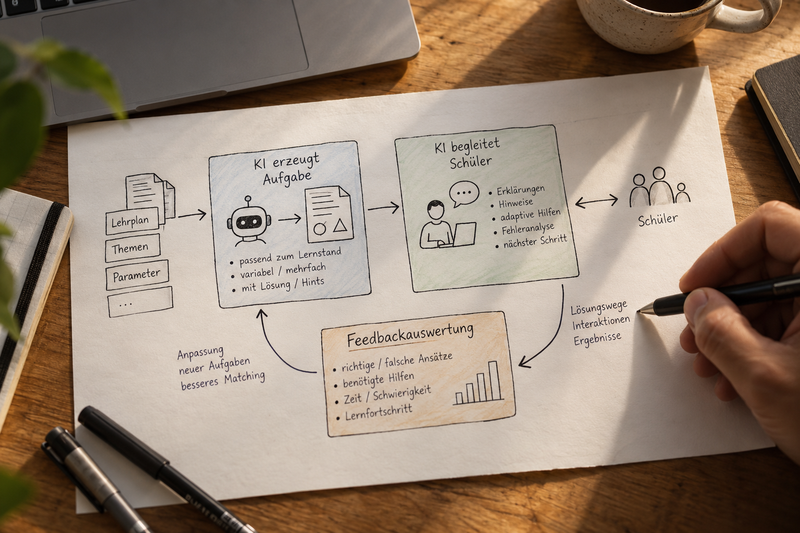
Designing a complete, GDPR-compliant, self-hosted AI system for individualized learning: one AI layer generates exercises and materials tailored to each student, another accompanies them directly, offering support while they work through it.

Consulting & speaking
Consulting and speaking are becoming central to what I do, not a side offering — talks and engagements grounded in the Open Autonomy philosophy and the Edo365 concept it produced, for schools and organizations exploring privacy-first AI adoption.
Selected projects

In development
edo365 is the practical application of Open Autonomy to education: not digitization or Scrum as an end in itself, but a student's real capacity to increasingly steer their own learning. Sprint, Flap, competency diagnostics and AI support are modules that can each be tested and dropped, not a fixed method — the teacher stays central throughout, shifting from directing to diagnosing and accompanying.

In development
edox is the format and technical implementation behind edo365 — not the renderer. It's a set of reusable material components (edodeck, edosheet, edoquiz, edokanban) that edowebbuild turns into static learning pages; printed and PDF output is edotex's separate job.

In development
A LaTeX compilation server written in Rust, with Tectonic embedded as an in-memory library — pooled sessions, streaming compile status, and an /info capability document designed for AI clients to consume directly. Runs today as the successor to the earlier Go-based gotex server and is being actively developed further.
Background
- NowOberstudienratMathematics, physics & computer science, Städtische Gesamtschule Stolberg (NRW).
- PriorDoctoral research, theoretical biophysicsForschungszentrum Jülich / Universität Düsseldorf — computational structural biology, GPU-accelerated molecular dynamics; PNAS publication.
- OngoingIndependent systems workedo365, edox and edotex — self-directed research and development toward AI-assisted, individualized education infrastructure.
Availability
I'm open to consulting engagements, talks and further projects at the intersection of AI, education and privacy-conscious system design. My focus in edtech goes beyond digital learning tools — it includes teaching methods rooted in computer-science thinking, from Scrum-based classroom processes to just-in-time instruction — for schools, edtech teams, and organizations thinking seriously about local-first AI.